For the technical reader
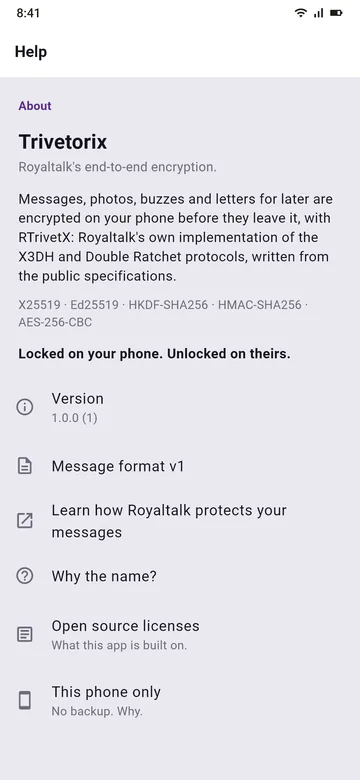
Royaltalk's 1:1 encryption is RTrivetX, our own implementation of the X3DH key agreement and the Double Ratchet, written from the public specifications (X3DH, Double Ratchet, XEdDSA), with standard algorithms: X25519, Ed25519, AES and HKDF (RFC 7748, RFC 8032, RFC 5869).
The package that holds it is Trivetorix: tri-, three; a trivet, the three-legged stand that holds a hot pot safely; -rix, king, as in Vercingetorix. Its three legs are X3DH, the KDF chain and the DH ratchet.
Group chats are coming soon. Their encryption is RTrivetium, our own implementation of sender keys, in the same Trivetorix package: each member's sender-key chain moves forward with the same HMAC step as the Double Ratchet's chain. Each sender key reaches every member over that member's own 1:1 end-to-end encrypted session, and the keys are replaced when someone leaves. A group will hold up to 1024 people.
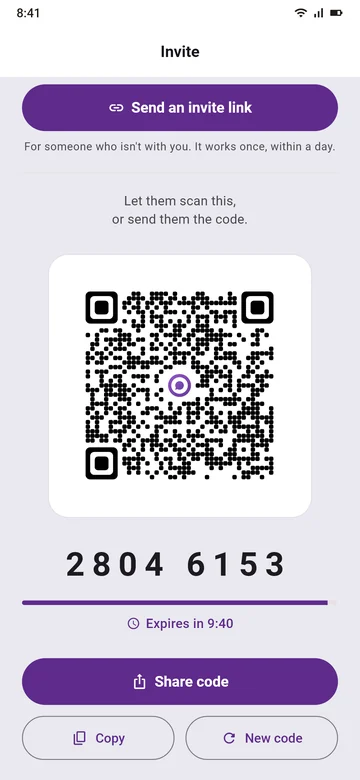
The first time two phones connect, each trusts the keys it receives, as most messaging apps do. When you connect by QR code or invite link, the app also checks the other phone's keys against a fingerprint carried inside the code.
We check our protocol design with ProVerif, a protocol-analysis tool. We test our tests with mutation testing, which plants small mistakes in the code to see whether the tests catch them.
Found a security problem? Write to security@royaltalk.in.